How Privacy works
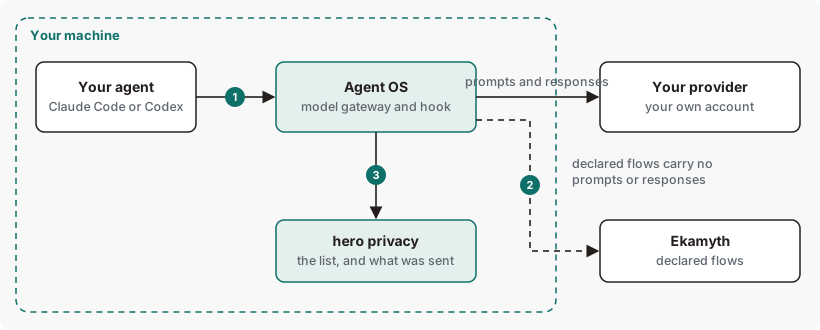
Ekamyth Agent OS runs on your machine. Your agents' model calls go to your own model provider and aren't on the list of what Agent OS sends. What Agent OS can send from this machine to Ekamyth is a declared list you can read.
How does Privacy work?
Your agents' model calls pass through the model gateway on your machine to your own provider. They aren't on the declared list. Separately, what Agent OS itself is built to send to Ekamyth is a declared list of eleven flows, and hero privacy shows it. None of those flows carries your prompts or your agent's responses. Three carry something you give it: rule compile carries a tokenized rule template, the access request carries the email you type, and code redeem carries the one-time code. hero privacy lists every declared flow and whether it's on, then the sends that went through Agent OS's own egress guard, which records them. Four of the eleven flows send without the guard, so they never appear in that record, and some sends happen outside the declared list; see Limits.
Privacy concepts
| Term | What it means |
|---|---|
| Declared flow | One kind of send Agent OS may make to Ekamyth, with what it carries and when it's on. |
| What actually left | The sends Agent OS recorded, per flow. |
| Not recorded | A flow whose sends are never listed in what actually left. hero privacy marks each one. |
What leaves your machine, step by step
- Your agent's model calls go to your provider, through the model gateway. They aren't on the declared list.
- Agent OS's own sends to Ekamyth are declared on a list, with what each carries and when it's on. Known sends outside the list are in Limits.
hero privacyshows both lists: what may leave, and what its egress guard recorded as sent.
What you work with in Privacy
hero privacy, and the two settings under What you can change.
What Agent OS can send from this machine, and when
| Flow | Carries | When |
|---|---|---|
Usage heartbeat (usage-beacon) | A random install id, version, platform and event | Usage reporting is on by default. It sends metadata only — never content, prompts or responses — at most once a day. Turn it off with HERO_BEACON=off. |
Plan check (learned-routing-plan-check) | This install's random installation id, to ask whether your plan includes learned routing | After you redeem a code: once when the model gateway starts, then every 15 minutes while it runs with learned routing on. The list names HERO_LEARNED_ROUTING=off to turn it off. |
Learned routing download (learned-routing-pull) | This install's random installation id | Only on a plan that includes learned routing; hero privacy prints this as Advanced only. The list names HERO_LEARNED_ROUTING=off to turn it off. |
Access request (preview-enrolment) | The email address you type | Only if you type one at hero setup |
Code redeem (preview-redeem) | The one-time code you were given, its handoff id, and the random installation id | Only when you redeem a code |
Rule compile (rule-compile) | A tokenized rule template | Automatic sending is paused by default. Manual hero compile can still send when an Ekamyth key is configured. |
| The other five flows | Anonymized decision metadata, aggregate token counts (usage-metrics), hourly token and verdict rollups, a content-free record anchor, and policy pulls | Off unless configured. hero privacy names the setting for each. The learning flows (decision metadata, aggregate token counts and hourly rollups) are off unless you set HERO_LEARN_URL. |
What stays on your machine
The declared list covers Agent OS's own sends. Agent OS doesn't block other network traffic on your machine, such as an API call made by a script your agent runs. hero privacy lists the flows Agent OS declares and shows what its egress guard recorded; it is not a complete record of this machine's traffic.
When the record of what left is incomplete
hero privacy marks four of the eleven flows NOT RECORDED: rule-compile, decision-metadata, usage-metrics and policy-pull. They send without going through the egress guard, the checked path that records Agent OS's sends, so their destination isn't checked and their sends never appear under what actually left. Most are off unless configured. See Limits.
Privacy on Claude Code and Codex
Same on both. The declared list belongs to the install, not to an agent.
What you can change in Privacy
| Setting | Default | Effect |
|---|---|---|
HERO_BEACON=off | On | Turns off the usage heartbeat. |
HERO_LEARNED_ROUTING=off | On (the row reads on even before you redeem) | Named by hero privacy as the way to turn off the plan check and the learned routing download. |
See Privacy for yourself
# What may leave, and what was recorded as sent
hero privacy

# Each recorded send
hero privacy --details
To read it line by line, see How to read the output.
Privacy limits and next steps
| Limit | What it means |
|---|---|
| Four flows not recorded | rule-compile, decision-metadata, usage-metrics and policy-pull send without the egress guard checking their destination. Most are off unless configured. |
hero compile status | Contacts the Ekamyth server outside the declared list. |
hero enforce on Codex | Makes the Codex app contact github.com. |
| One local Monitor data endpoint | It can return facts the privacy screen would normally hide. No screen in the Portal requests them, and nothing leaves your machine. |
For every limit of the command, see Limits of hero privacy.
Checked against Agent OS 0.1.36rc14 (build 599c5e120c18) on 17 Nov 2026.